



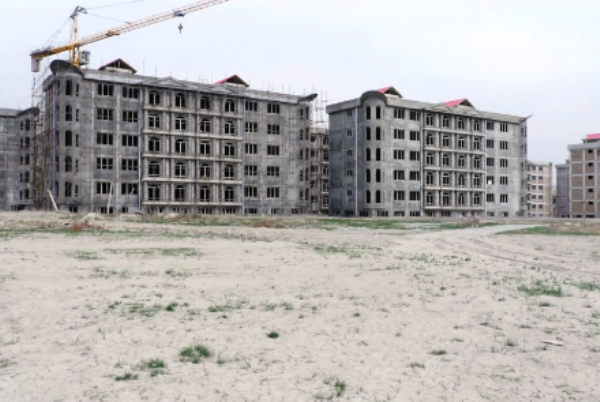
The “Nileh Bagh” residential project, one of the key housing initiatives, has raised hopes for reducing the housing shortage in the capital.
The project, which is being implemented in cooperation with China, is considered part of broader plans to improve the living conditions of citizens.
According to officials from the Ministry of Urban Development and Housing, construction work has reached nearly 60 percent completion. The project is expected to be finalized by Hoot 1405 (solar calendar), after which it will be handed over to the ministry and the distribution of housing units will begin.
Kamal Afghan, spokesperson for the Ministry of Urban Development and Housing, said: “The Nileh Bagh project is being implemented in cooperation with China. It includes 10,000 housing units, and the remaining units will be constructed in other parts of Kabul city. Suitable locations have already been identified for the remaining blocks.”
The Nileh Bagh project is designed on a land area of 106 jeribs, where 56 residential blocks comprising 1,400 apartments will be constructed.
Currently, around 400 Afghan workers and nearly 100 Chinese workers and engineers are engaged in the project.
Khushal, an engineer at the ministry, said: “On average, this project has the capacity to accommodate around 5,000 people. About 400 Afghan workers and nearly 100 Chinese engineers and workers are currently employed.”
Economic experts believe that the implementation of such projects can play a significant role in economic growth, job creation, and improving citizens’ living conditions.
However, they stress that transparency in both implementation and distribution processes will be key to the success of such initiatives.
Sayed Masoud, an economic expert, said: “We hope the Chinese will view this project as a positive step, and that it will be managed in a way that their involvement in housing development is seen as a constructive move.”
It is worth noting that the Nileh Bagh residential project was officially launched on 19 Hamal 1403 (solar calendar) with an investment of $71 million by a Chinese company.