




By Zhao Jingru
At the opening ceremony of China’s 15th National Games in Guangzhou, South China’s Guangdong Province, a 174-meter digital scroll in an oil-painting style drew particular attention. Blending technology with art, it showcased the magnificent landscapes of Lingnan with breathtaking splendor.
Unlike traditional production techniques, this scroll was fully and autonomously generated by more than 2,000 AI agents.
“It’s hard to believe this stunning painting wasn’t painted with real pigments but created by AI. It doesn’t have that usual ‘techy’ or mechanical feel – instead, it captures the softness and delicate beauty of real art,” Chen Xingyi, a 26-year-old sports fan who watched the opening ceremony on site, told the Global Times.
This wasn’t the only thing that amazed Chen. In the following days of watching the Games, she found besides the visual appeal, other technological application brought her an unprecedented convenience, such as easy navigation to destinations, undergoing fast security checks.
Chen’s experience is one of countless examples showing how China’s 15th National Games is leveraging cutting-edge technology to upgrade the experience of ordinary spectators.
In October, the National Development and Reform Commission, together with other relevant departments jointly issued a notice on an action plan, aimed at deepening the development of smart cities and promoting comprehensive digital transformation. The document proposes to create new digital lifestyle scenarios such as digital-empowered cultural tourism, sports and accelerating the digital transformation of cultural and sports facilities, including stadiums and gymnasiums.
This aligns with the digital sports development goals outlined in the 14th Five-Year Plan for Sports Development (2021-25) released in 2021, which requires applying digital technologies to promote sports development, including digital governance in the sports sector and digitalization of sports competitions.
Based on the experience of individuals and companies that have either benefited from or provided technological support for the 15th National Games, the Global Times reveals how innovative technologies are unlocking new avenues for the public to engage deeply with sports culture, while also demonstrating their potential to deliver intelligent “urban services” that integrate technological benefits into all aspects of public life.
Cheap tickets, awesome views
During her years studying abroad, whenever Chen wanted to attend one of her favorite sporting events – whether football, tennis, or something else – she often found herself caught in a dilemma: Should she pay for a better seat, or save money and settle for a less ideal view?
With limited budget, almost every time Chen would end up sitting high up in the stands or off to the side in cheaper tickers – craning her neck, squinting her eyes and relying on the overhead screens or her phone’s zoom function to follow the game.
“It’s exciting to see my favorite players or a great match,” she recalled, “but by the end, my eyes would ache and my body would feel tired. Sometimes I’d even miss the most thrilling moments.”
This year’s National Games, however, completely changed her perception of what a live sports experience can offer. For the first time, she said, even with an affordable “mountain-top ticket,” she could sit back and still have a clear, immersive view of the action – no awkward postures and no external devices.
“There were four enormous HD screens arranged as a giant cube hanging in the center of the stadium,” Chen told the Global Times. “Even from the back, the view was so clear that I could see the players’ expressions and feel fully immersed in the game’s electric energy.”
The cube-shaped display Chen described is China’s first “retractable roof integrated with a movable cube display” system. The Global Times learned from its developer – Shanghai Sansi Technology Corp that it operates in sync with the venue’s retractable roof and intelligent adjustable lighting systems, enabling rapid reconfiguration of the arena to meet the needs of different events.
A spectator surnamed Zhang told the Global Times that what delighted him most about attending the Games was being able to livestream and share the excitement of the matches with his family in real time.
According to Shenzhen Special Zone Daily, the Shenzhen Sports Center – one of the main venues – has been equipped with more than 4,200 signal antennas and nearly 1,800 Wi-Fi access points to ensure full coverage with dual-gigabit networks.
“My grandparents are big sports fans, but too old to travel far,” Zhang said. “Thanks to the stable Wi-Fi in the stadium, I could video-call them – chatting while showing them the live atmosphere and the matches in real time.”
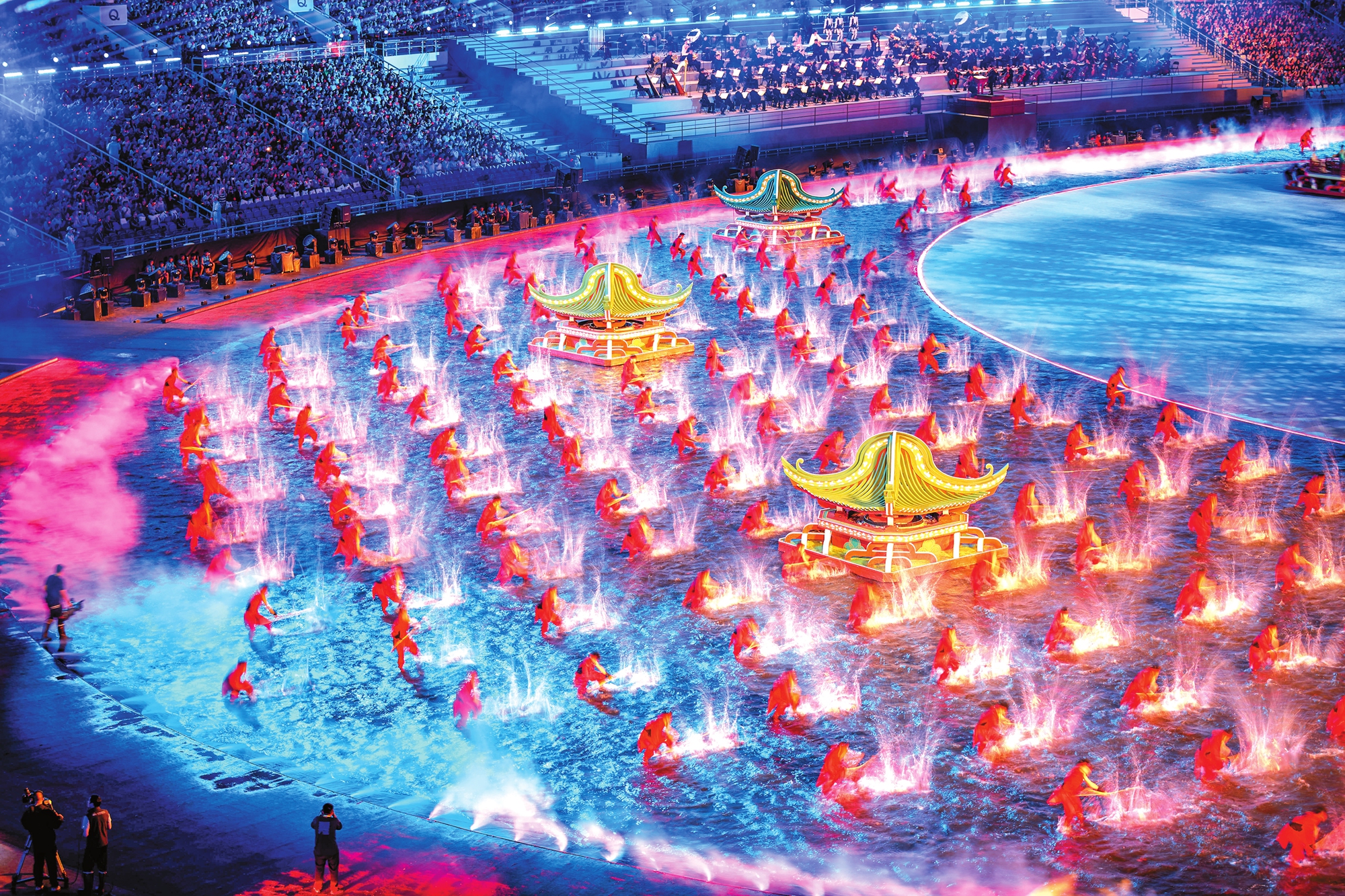
A digitally-enhanced spectacular performance is presented during the opening ceremony of China’s 15th National Games in Guangzhou on November 9, 2025. Photo: VCG