



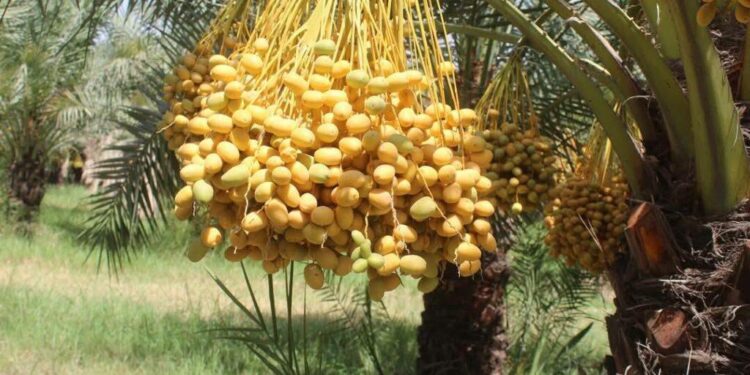
The Hada Date Palm Orchard, run by the Wadey Emirati Agricultural Company in Nangarhar, has seen an increase in yield compared to last year, with an estimated production of over 20 tons.
Abdul Qayum Atrafi, who has been managing the orchard for the past seven years, stated that the orchard was established in 2010 with date palm saplings imported from the United Arab Emirates, and currently produces six different varieties of dates for the market.
Abdul Qayum Atrafi, manager of the Hada Farm Date Orchard, said: “There are around 2,700 date palm trees in this orchard. Whenever there’s a disease outbreak, we have a plant protection team that we inform immediately. We have six varieties of dates here, and we expect this year’s yield to surpass last year’s. We’ve also established another 25-jerib orchard in addition to this one.”
Officials from Nangarhar’s Department of Agriculture, Livestock, and Chambers of Agricultural Production, along with orchard workers, noted that thousands of tons of dates are imported into Afghanistan annually. They urge the caretaker government and private sector to invest in domestic date orchards to reduce reliance on imports.
Ajmal Rahmani, head of Nangarhar’s Agriculture, Livestock, and Production Chamber, said: “To prevent the import of thousands of dates from countries like Iran, the UAE, and others, we must establish our own orchards. We need to produce locally and meet our own market demands.”
Another worker, Abdul Mubeen, added: “If more orchards like this one are built, more job opportunities will be created for the people.”
Officials from the Wadey Emirati Agricultural Company in Nangarhar said they expect more than 20 tons of dates to be harvested this year and that they are intensifying efforts to promote date cultivation in the province.
Company spokesperson Sayed Homayoun Gharibmal stated: “This company has established date orchards on 65 jeribs of land. From 40 jeribs of that, we harvest dates on a large scale every year. Last year, we had a good yield, but it was severely affected by rain, hail, and wind.”
There is a growing belief that if the government and private sector focus more on establishing local date orchards, domestic production could eventually replace imports and meet market demand.