


By: NoorWali Khpalwak
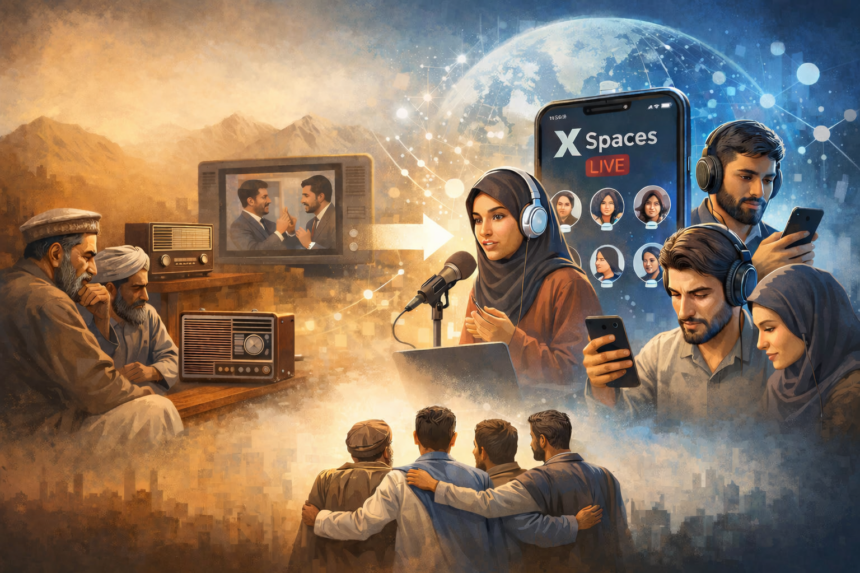
For many years, Afghan political and social discussions were confined to limited frameworks. Radio, television, and printed newspapers were the only platforms for the exchange of ideas. People would sit beside radios and televisions during the day and in the evening, listening to news and analyses, or particularly watching political debates on television screens. Newspapers were largely limited to urban centers and reached only a small segment of society. Although these media outlets were influential, they were essentially one-way platforms; people were listeners, not participants.
Today, however, this picture has completely changed. With the emergence of social media—especially following the activation of X (formerly Twitter) Spaces—the nature of political and intellectual discourse has fundamentally transformed. Afghans are no longer merely passive listeners; they have become active participants in discussions. This transformation is not only technical, but also intellectual, political, and social in nature.
X Spaces present a new model of dialogue in which geography, fear, censorship, and formal constraints have been broken. An Afghan sitting in Kabul can, at the same moment, engage directly in discussion with Afghans in Europe, the United States, Australia, or the Middle East. This is an opportunity that was previously unimaginable. It is precisely this feature that has made X Spaces several times more impactful than traditional media platforms of the past.
In the old model, discussion agendas were predetermined. Guests on television programs were carefully selected, conversations were largely controlled, and the voice of the general public had little space. In X Spaces, however, these walls have been dismantled. Anyone with an opinion can speak, ask questions, criticize, and even directly debate opposing viewpoints. While this freedom is a blessing on one hand, it is also a serious test on the other.
These Spaces are no longer simple conversation gatherings. Political, cultural, and civil society activists monitor them closely. Afghans living in different parts of the world follow these discussions, take notes, and analyze them. Even individuals who previously had little interest in politics have now moved closer to political awareness through this platform. This, in itself, is a major achievement of this new media phenomenon.
On the other hand, it is an undeniable reality that the current system in Afghanistan also closely monitors X Spaces. These discussions reflect the temperature of public opinion. Every sharp statement, every wave of support, and every widespread objection draws the attention of policymakers. Therefore, X Spaces are not merely virtual voices; they also influence the real political environment.
This is where the issue of responsibility arises. When a media platform holds such broad influence, negligence becomes dangerous. If these discussions drift toward personal grudges, ethnic biases, linguistic conflicts, and emotional slogans, they deepen problems instead of offering solutions. Unfortunately, in some Spaces, signs have emerged where differences turn into hostility and criticism descends into insult.
Afghan society, which is still passing through the aftermath of wars, mistrust, and deep wounds, can no longer afford division. We must understand that every harsh and irresponsible statement—even if made in a virtual space—has real consequences. Such words shape mindsets, provoke emotions, and deepen lines of division rather than unity.
However, if X Spaces are managed properly, they can become the cheapest, fastest, and most effective tool for Afghan unity. Management does not simply mean muting speakers; rather, it means building a culture of dialogue. It means transforming disagreement into constructive debate, viewing opposing opinions not as enemies but as fellow Afghans, and placing national interests above personal emotions.
In the past, people could only hear the voices of a few limited figures through radio and television. Today, there is an opportunity for the voice of the ordinary Afghan to be heard. If this voice expresses pain, migration, unemployment, education, and concerns about the future, it becomes a national asset. But if it is used solely for hatred, insult, and blame, it becomes the greatest betrayal of this new medium itself.
We must spread love through this platform—not love as a slogan, but love as behavior. This means giving others the chance to speak, accepting differences of opinion, and acknowledging that Afghanistan does not belong to a single ideology, language, or group. This country is the shared home of all Afghans, whether inside the country or abroad.
X Spaces can serve as a rehearsal for shaping the intellectual map of Afghanistan’s future. If we practice healthy dialogue here, the culture of understanding will strengthen in real life tomorrow. If we learn to listen to one another here, we will gain the capacity to accept one another tomorrow. But if this space becomes poisoned, it will send a dangerous message for the future.
Today, Afghanistan has distanced itself somewhat from armed conflict, but the battle of ideas continues. If this struggle is guided by reason, ethics, and national thinking, it will be victorious. If it is driven by emotion and prejudice, it will fail. X Spaces represent the new front line of this battle, and it is up to us to decide whether this front becomes a site of construction or destruction.
In conclusion, X Spaces should neither be treated as sacred nor as dangerous. They are simply a tool. How this tool is used depends on our intentions, awareness, and sense of responsibility. If we can use this new media space to promote national unity, mutual respect, and a shared vision for a better future, it will become an important chapter in Afghan history.