


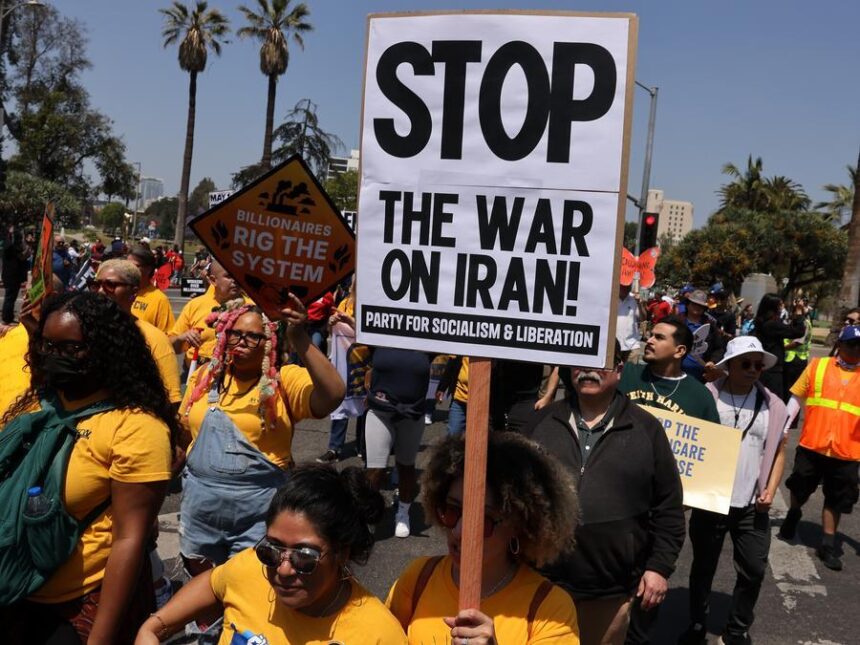
The United States and Iran on Monday announced the finalization of a memorandum of understanding (MoU) to end hostilities following months of negotiations.
Despite widespread viewing of the agreement as an important step toward peace, it does not resolve the underlying disputes, leaving the future trajectory of U.S.-Iran relations and the regional situation still shrouded in uncertainty.
WHAT’S IN THE DEAL?
U.S. President Donald Trump said earlier in the day that the U.S.-Iran peace deal “is now complete” and that the Strait of Hormuz will reopen upon the signing of the deal on Friday.
The deal would also include a commitment from Iran not to obtain nuclear weapons, Trump told The Wall Street Journal.
There would be strong nuclear inspections on the Iranians, Trump said, without specifying how they would work. He also expressed no urgency to extract nuclear material from Iran, saying “there’s no rush.”
Iranian Foreign Ministry spokesman Esmaeil Baghaei stressed on Monday that ending the war in Lebanon is an “inseparable” part of the finalized MoU.
He listed some of the other provisions in the deal, including the release of Iran’s frozen assets and the reconstruction of the damage sustained by the country during the war, stressing that under the deal, the United States commits to implement measures regarding both issues.
The exact terms of the MoU are not publicly available so far. Details will be made public within next 24 to 48 hours, according to media reports on Monday.
“The United States showed greater flexibility regarding some Iranian demands related to lifting or gradually easing sanctions, while Iran likely accepted additional restrictions and monitoring measures related to its nuclear program,” Palestinian political analyst Mustafa Ibrahim told Xinhua.
“What happened does not reflect a victory for one side over the other, but rather an attempt to reach a middle ground that achieves the minimum interests of both sides,” Ibrahim said.

HOW’S THE DEAL VIEWED?
Countries and international organizations have welcomed the finalization of the MoU and called for its full implementation to help achieve lasting peace.
UN Secretary-General Antonio Guterres welcomed the deal, and hoped that the parties would build on this new momentum and redouble their efforts toward a final resolution of the conflict, his spokesperson said Sunday.
Britain, France, Germany and Italy also welcomed the MoU, saying in a joint statement that they were “prepared to lift relevant sanctions in response to clear, verifiable steps by Iran on its nuclear program.”
Ahmed Aboul-Gheit, secretary-general of the Arab League, said he hoped the development would mark an important step for bringing a definitive end to attacks on Arab territories, and help create conditions conducive to launching a process aimed at ending the conflict and achieving lasting stability in the region.
He called on the parties involved to approach the next phase of negotiations on key issues in a positive spirit and work toward a peaceful resolution of the crisis.
Lebanese President Joseph Aoun said the MoU could help end military escalations in the region, including in Lebanon. He commended the deal’s recognition that Lebanon’s security and stability are essential for achieving regional stability.

WHAT COMES NEXT?
Analysts say that some of the consensus achieved is of great significance. First and foremost, the reopening of the Strait of Hormuz would help ease tensions in global energy markets.
However, many key issues remain unresolved, and the real test will come after the MoU is signed in Switzerland.
“Technical negotiations on Iran’s nuclear file will prove difficult,” researchers at the U.S. think tank the Center for Strategic and International Studies said in a commentary. “The last time Iran and the United States secured a comprehensive nuclear accord was in 2015, after two years of negotiations.”
“Tehran has signaled an unwillingness to compromise on key demands and will try to play for time, knowing that President Trump is unlikely to resume the military campaign in the run-up to the November midterm elections,” they said.
Another factor shaping the peace prospects is the conflict along the Israel-Lebanon front.
“The Israel-Lebanon front has become part of a much larger regional equation. What happens there affects not only Israel and Lebanon but also calculations in Washington, Tehran, and other regional capitals,” Palestinian political analyst Abdel Majid Suwailem told Xinhua.
“An escalation could create a political atmosphere in which compromise becomes more difficult and security concerns take precedence over diplomacy,” Suwailem added.
“The reported agreement appears to focus on urgent issues necessary to halt escalation … More contentious subjects have been deferred to future negotiations,” said Aram Kiwan, an Arab Israeli political analyst and columnist, noting that he sees the most likely scenario as a lengthy, phased negotiating process.