



By Tao Mingyang and Qi Xijia
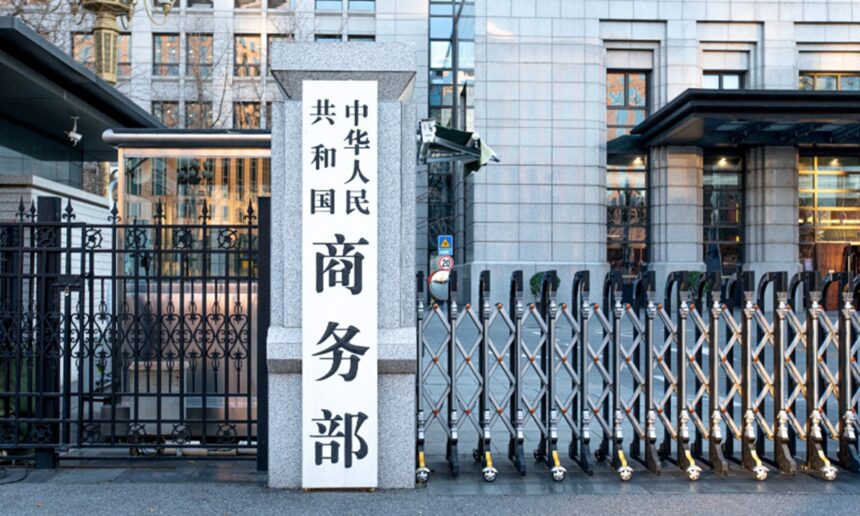
China has rolled out a series of countermeasures against a slew of US firms on the first working day after the Dragon Boat Festival holiday. China’s Ministry of Commerce (MOFCOM) and Ministry of Finance (MOF) unveiled separate restrictive measures targeting US entities on the same day, a move that a Chinese expert said was aimed at responding to Washington’s groundless practice of arbitrarily blacklisting Chinese companies.
The measures are a response to Washington’s repeated weaponization of unilateral sanctions and entity lists to suppress Chinese enterprises, including its groundless addition of Chinese firms to its so-called military-industrial entity list, the expert added.
China has added 10 US entities to its export control list in accordance with the nation’s export control law and regulations on export control of dual-use items, according to an announcement issued by the MOFCOM on Monday.
Exporters are barred from exporting dual-use items to the listed entities, while institutions and individuals from any country and region are prohibited from transferring or supplying dual-use items of Chinese origin to these entities, it said.
Any export demand arising from special, genuine necessity must acquire approval from MOFCOM. The announcement took effect immediately upon release, according to the statement.
The listed companies, spanning from aerospace, defense, robotics, maritime services and rare earths sectors, include Aveox, Red Cat Holdings, Teal Drones, IMSAR, Jaia Robotics, Ball Aerospace & Technologies Corp, Oshkosh Defense, L3Harris Maritime Services, MP Materials Corp, and USA Rare Earth.
In a separate statement, a spokesperson for the MOFCOM said that the measure was taken following the “malicious” practice of the US government in adding more Chinese firms to a so-called list of companies linked to the Chinese military, in accordance with the Export Control Law and relevant regulations on dual-use items, and is aimed at safeguarding national security and interests, and fulfilling international obligations such as non-proliferation.
Meanwhile, the MOF announced that it has decided to take relevant measures against 46 US companies in government procurement activities in accordance with relevant laws and regulations.
Under the measures, procuring entities in government procurement activities are prohibited from purchasing products manufactured by the 46 US companies, excluding products manufactured by US-funded enterprises operating in China.
The restricted US companies include Lockheed Martin Corporation, Raytheon Missiles & Defense, Boeing Defense and Space & Security. The notice took effect on the date of issuance, said MOF.
China’s control measures feature well-defined boundaries, targeting only items tied to military supplies and military manufacturing. In stark contrast, the US arbitrarily broadens its crackdown scope, fabricating fictitious military links for companies with zero military relevance as an excuse to target China’s high-tech sector, Li Yong, an executive council member of the China Society for WTO Studies, told the Global Times on Monday.
Song Guoyou, deputy director of the Center for American Studies at Fudan University, added that the measures can be understood as a concrete step to safeguard the legitimate interests of Chinese entities and companies.
Reasonable, lawful regulation
The two measures came after earlier this month the US Defense Department expanded its list of what it describes as Chinese military companies under Section 1260H of the National Defense Authorization Act. Major Chinese technology and manufacturing firms including Alibaba, BYD, Nio, CALB Group and Unitree Robotics have all been added to the list.
Regarding this, Chinese Foreign Ministry spokesperson Lin Jian said that China consistently opposes the US overstretching the concept of national security, abusing its entity list and other export controls, and suppressing Chinese enterprises, adding that the US should stop politicizing, instrumentalizing and weaponizing trade and tech issues.
In response to the earlier US crackdown on Chinese firms, a MOFCOM spokesperson said in a statement that China strongly deplores and firmly opposes the US’ move of listing certain Chinese firms as “military companies”, noting that US side has ignored the consensus reached during the meeting between the heads of state of the two countries in Beijing, disregarded the overall interests of bilateral economic and trade relations, continuously generalized the concept of national security, and abused state power to unjustifiably suppress Chinese enterprises.
The spokesperson said that the US move has seriously disrupted the international economic and trade order, undermined the stability of global industrial and supply chains, and severely harmed the legitimate rights and interests of Chinese enterprises.
China has consistently advocated resolving differences through dialogue and consultation and implementing the important consensus reached by the two heads of state, said Zhou Mi, a senior researcher at the Chinese Academy of International Trade and Economic Cooperation, while noting that the US has continued to introduce new restrictive measures against Chinese companies despite this recent consensus, increasing both market and reputational risks for firms, as well as uncertainty for their business partners.
“Such actions run counter to the consensus, are not conducive to the stable development of China-US economic and trade relations, and weaken the foundation for cooperation mechanisms between the two sides,” Zhou said.
Some analysts said the US has continuously broadened its concept of national security and abused state power to unfairly suppress Chinese enterprises and products, seriously disrupting the international economic and trade order and even affecting its own manufacturers and traders.
Zhou said the two restrictive measures against US companies were based on clear factual and legal grounds. “Companies included in export control lists or government procurement restrictions may be involved in issues affecting China’s national security, international non-proliferation obligations, or non-compliance with relevant Chinese policy requirements,” he noted.
Among the ten listed entities subject to China’s export control, Aveox develops drone and aviation systems; Red Cat Holdings and its subsidiary Teal Drones are major producers and exporters of autonomous military and commercial drones; IMSAR specializes in synthetic aperture radar systems widely used in military reconnaissance and surveillance; while Jaia Robotics focuses on autonomous underwater vehicles and maritime monitoring equipment for naval reconnaissance and underwater defense missions, the Global Times has found.
According to Taiwan island-based Central News Agency, more than 20 US drone, counter-drone and unmanned underwater system manufacturers visited the island in September 2024 as part of an official trade delegation organized by the American Institute in Taiwan. Jaia Robotics participated in the three-day defense-industry matchmaking event. In the 2025 September, teams from L3Harris Maritime Services, also a listed US firm, and Red Cat Holdings attended the Taipei Aerospace & Defense Technology Exhibition.
Zhang Junshe, a Chinese military affairs expert, told the Global Times on Monday that although the MOFCOM document does not explicitly mention Taiwan-related activities, the targeted companies are deeply involved in matters concerning Taiwan and play important roles in the US arms-sales chain to the island. They have not only directly supplied military drones and other weapons to Taiwan, but have also engaged in extensive military cooperation with the island, including the transfer of military equipment production technologies, said Zhang.
Such activities, Zhang said, have seriously undermined China’s national security and core interests, emboldened “Taiwan independence” separatist forces to continue provoking the mainland, and disrupted the process of China’s peaceful reunification. He argued that the restrictive measures are both justified and necessary, as they help cut off material and technological support from external forces to separatist elements at the source and safeguard China’s core interests regarding the Taiwan question.
As for the MOF’s government procurement restrictions targeting certain US companies, He Weiwen, a senior fellow at the Center for China and Globalization, told the Global Times on Monday that the policy’s distinction between US-funded enterprises operating in China and US companies based in the US is a reasonable and prudent arrangement.
He noted that the measures have clearly defined boundaries and are highly targeted, focusing on specific entities rather than all US-invested companies. “The approach helps maintain policy transparency, consistency and predictability, while demonstrating China’s efforts to balance safeguarding national interests with maintaining a high level of openness,” said He, adding that this kind of policy certainty is conducive to stabilizing foreign investors’ expectations.