


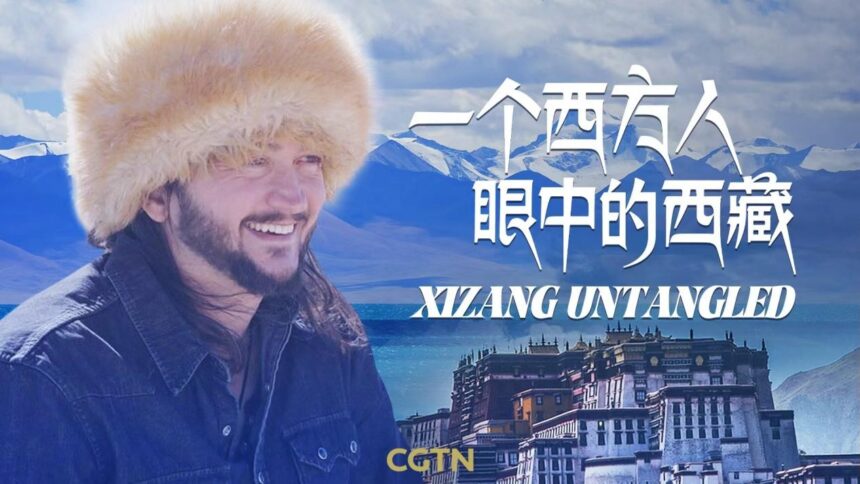
In an effort to present a fuller and more nuanced picture of Xizang to global audiences, a new three-part documentary series, Xizang Untangled, is set to be released by CGTN. The series aims to highlight Xizang’s achievements in poverty alleviation, religious freedom, and environmental protection, while addressing longstanding controversies and misconceptions often amplified in Western discourse.
By combining on-the-ground reporting with personal storytelling, the series seeks to move beyond abstract debates and geopolitical narratives. Instead, it focuses on lived experiences and tangible realities, using facts to challenge prejudice and details to rebuild a more accurate understanding of Xizang. The documentary also explores how cultural exchange can bridge gaps created by language and perception, fostering a more constructive international dialogue.
It features American comedian and journalist Lee Camp, who travels across Xizang to offer an outsider’s perspective shaped by direct observation and interaction. His journey provides viewers with a fresh lens: one that contrasts with dominant narratives and emphasizes firsthand experience over secondhand interpretation.
In the opening episode, Lee joins a group of “guardians of the plateau”–including two female conservationists, monks, and local wildlife workers–working to protect Xizang’s fragile ecosystem.
Disguised in camouflage gear, he accompanies researchers tracking wildlife such as the white-lipped deer, while also meeting monks who see rescuing injured animals as part of their spiritual practice. Local patrol teams, equipped with deep ecological knowledge, play a crucial role in monitoring biodiversity across vast landscapes.
What emerges is a holistic approach to environmental protection. Conservation here is not limited to scientific management or policy enforcement; it is embedded in cultural values that emphasize respect for all living beings. From endangered species to stray animals, the principle of compassion extends across the ecosystem.
For Lee Camp, this experience reshapes his understanding of environmental governance in Xizang. It reveals a model where ecological protection is not just a technical endeavor, but a shared social commitment and way of life.
The second episode shifts focus to rural development, following Lee’s visit to Sanyou Village along the Lhasa River in Qushui County. Accompanied by a resident village official, he explores how local governance operates at the grassroots level.
Through direct engagement with villagers and officials, Lee witnesses a range of livelihood initiatives: a lottery-based housing allocation system designed to ensure fairness, community centers that function as mutual aid hubs, and small-scale workshops that generate employment and income.
These localized, human-centered practices challenge the stereotype of Xizang as isolated or underdeveloped. Instead, the episode highlights how modernization is unfolding alongside cultural continuity, and how national policies are translated into practical, everyday improvements in people’s lives.