




By Li Xuanmin
China’s GDP expanded 4.6 percent year-on-year to reach 107.11 trillion yuan ($16 trillion) in the first nine months, data from the National Bureau of Statistics (NBS) showed on Monday. The freshly released figure landed well within the annual GDP growth target of around 4.5 percent to 5 percent for this year, showing that the world’s second-largest economy continues to operate on the sound trajectory, and laying a solid foundation for achieving the full-year growth target, Chinese analysts said.
In the third quarter, China’s GDP grew 4.5 percent year-on-year, accelerating from the 4.3-percent growth recorded in the second quarter. In the first quarter, China’s GDP jumped 5 percent, NBS data showed.
Observers said the third-quarter reading reflects multiple factors, including the manufacturing strength of China’s high-tech and equipment sectors, which continued to underpin robust external demand, the strong drive from new and emerging industries, as well as the steady progress in the course of high-quality development.
Amid mounting uncertainties, the steady growth of the Chinese economy – which serves as both the “world’s market” and a “super buyer” – is an anchor of growth, channeling much-needed certainty to the world economy, analysts said.
‘New, high-quality development’
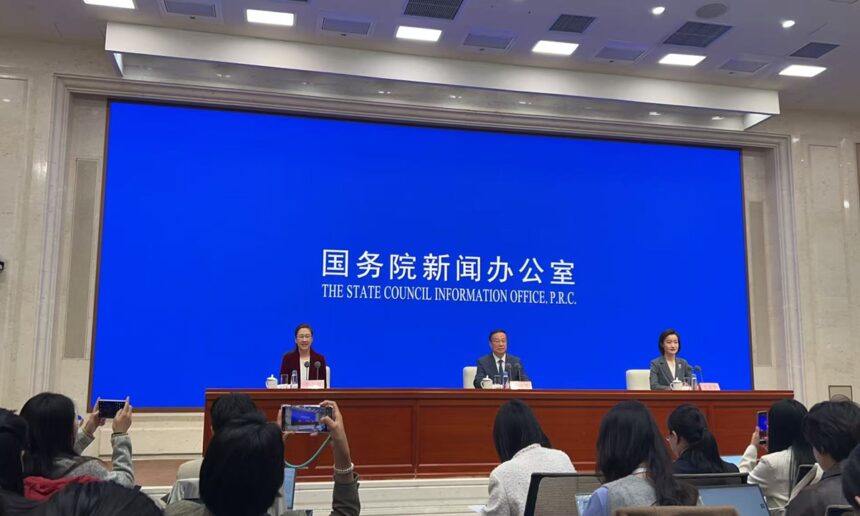
“Based on the forecasts by some international institutions, China’s growth rate of 4.6 percent still leads among the world’s major economies. Also, in terms of absolute increase, the Chinese economy in the first three quarters added 5.7 trillion yuan in output, the largest increment in the past five years,” NBS deputy head Mao Shengyong said at a press briefing of the State Council Information Office on Monday.
China’s 5.7 trillion yuan increment in economic output in the first three quarters is roughly equivalent to the annual GDP of Belgium, the world’s 23rd largest economy.
Mao also stressed that China’s third-quarter GDP growth rebounded by 0.2 percentage point from the second quarter, which is “hard-won and highly commendable,” as the greater impact of higher international oil prices caused by the Middle East conflict led some international institutions to lower their third-quarter growth forecasts for major economies compared with the second quarter.
“The Chinese economy demonstrated a clear trend of advancing toward new and higher-quality development in the first three quarters, with growth momentum shifting toward new drivers from old ones,” Hu Qimu, a professor at the Maritime Silk Road Institute of Huaqiao University, told the Global Times.
“China has achieved almost the best result it can taking account of amassing downward pressures, especially the increasingly complicated geopolitical environment,” he added.
One of the major takeaways from the first nine months data is the continuous improvement of economic structure, as “what matters more at this stage of economic upgrade and transformation is the quality,” analysts said.
According to the NBS data, China’s value-added industrial output of above-scale enterprises in the first nine months rose 5.3 percent compared to the same period in 2025.
Meanwhile, new growth drivers continued to gain ground, with contributions to the overall economy exceeding 40 percent in the first three quarters. The value-added of high-tech manufacturing rose 14.3 percent, while equipment manufacturing grew 10.2 percent.
Also, output of 3D printing equipment, lithium-ion batteries and industrial robots surged 62.5 percent, 39.5 percent and 29.1 percent, respectively.
China’s resilient production and relatively rapid export growth have played an important role in boosting the economy in the third quarter, especially in the manufacturing of high-tech products related to artificial intelligence (AI), chips and new-energy vehicles.
“China’s economic growth stems from overall optimization rather than short-term gains driven by any single indicator or policy stimulus. The reality is very different from the pessimism peddled by some foreign media, as they often cherry-pick a single indicator for one-sided interpretation, deliberately stoking market concerns,” Zhou Mi, a researcher at the Chinese Academy of International Trade and Economic Cooperation, told the Global Times on Monday.
Full-year target
In the January-September period, China’s fixed-asset investment dropped by 7.2 percent year-on-year, while total retail sales of consumer goods and services expanded by 2.6 percent year-on-year, according to the NBS data. Among which, retail sales of services rose 5 percent year-on-year in the first nine months, 4 percentage points faster than that of goods.
While internal demand continued to recover in the third quarter, economists pointed to more signs of improvement in September, suggesting that policy support and seasonal factors were beginning to take effect and reinforcing the economy’s underlying resilience.
Analysts attributed the improvement partly to the earlier timing of the Mid-Autumn Festival, which lifted spending on essential goods, alongside support from “more proactive and effective” macro policies, and a low base effect from last year.
“Internally, the Chinese economy faces several challenges, including insufficient domestic demand, weak consumer confidence, and a property market downturn that continues to weigh on the recovery of fixed-asset investment. Externally, uncertainties in the Middle East and trade disputes among major economies could pose pressures on the economic outlook,” Tian Yun, a Beijing-based veteran economist, told the Global Times.
Despite the headwinds, observers voiced confidence that the Chinese economy will maintain strategic composure and continue to advance in a new and better direction.
While the series of pro-growth policies launched since September could further stabilize and guide market expectations, more incremental policies are also expected to address modest consumption and investment in the fourth quarter – the final stretch of 2026 and a critical window for consolidating the economy’s recovery and upward momentum.
Observers believe that the economic operation in the first nine months has set the tone for the country to achieve the full-year GDP growth target of 4.5 to 5 percent.
“The ongoing transformation toward new drives will not only improve the quality of growth and enhanced the economy’s resilience and dynamics but also provided a solid buffer against external uncertainties,” Tian stressed.
The freshly released data also squarely rejects the pessimism some doomsayers have been spreading about the Chinese economy.
In the past, China was often described as the “world’s factory” and a “super seller” thanks to its strong production capacity. Now, with imports growing by more than 20 percent, China has also become the “world’s market” and a “super buyer,” reflecting the relatively strong comprehensive competitiveness of its industries, Mao said at the press briefing.
Tian added that the set of figures has further highlighted China’s positive contribution to the global economy.
“In fact, China’s contribution to the global market today is not simply a matter of how large a share of global GDP it accounts for. It is now the world’s second-largest consumer market, indicating its important role as a major source of demand and the enormous development opportunities it offers to the world,” Tian said.