



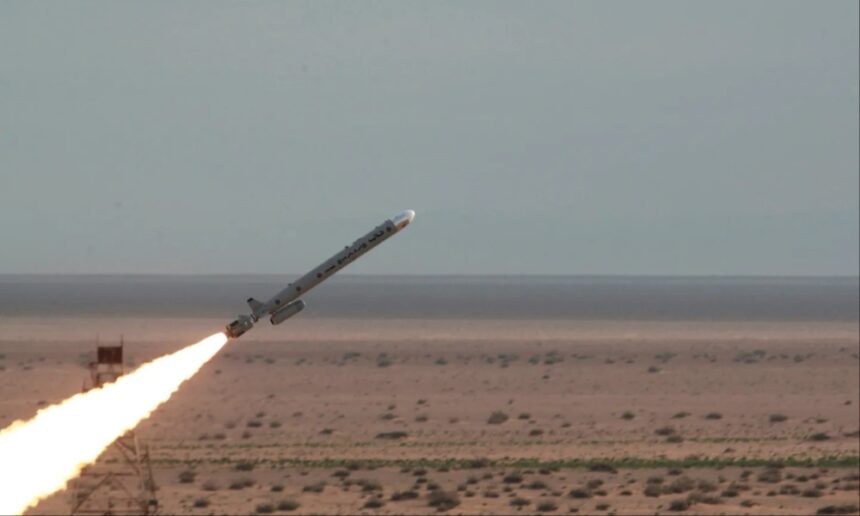
The United States carried out multiple waves of airstrikes against Iran early Monday, targeting military infrastructure in response to Tehran’s recent attack on a commercial container ship in the Strait of Hormuz, while Iran retaliated by launching missiles and drones at several countries hosting US military forces across the Middle East.
The latest escalation marks one of the most intense exchanges since the conflict began earlier this year, raising fresh concerns about regional stability despite ongoing diplomatic efforts aimed at securing a lasting ceasefire.
According to the US Central Command (CENTCOM), approximately 140 targets were struck during the operation, including missile and drone launch sites, ammunition depots, communications facilities and other military installations.
“The Strait of Hormuz is a vital maritime corridor for global trade,” CENTCOM said in a statement.
“Iran does not control it. US forces are postured and prepared to ensure that freedom of navigation remains available to commercial shipping despite Iran’s continued unwarranted aggression, harassment, threats and arbitrary declarations.”
President Donald Trump defended the operation, saying in an interview with NBC’s Meet the Press: “We bombed the hell out of them last night.”
Iranian state media reported explosions in several locations across the country early Monday and said at least one person had been killed in the strikes.
In response, Iran launched missiles and drones toward several Gulf states, triggering air defence systems across the region.
Missile warning sirens sounded in Bahrain, home to the US Navy’s Fifth Fleet, while Kuwait said its air defence systems intercepted incoming projectiles. There were no immediate reports of casualties or significant damage.
Iran’s retaliatory strikes also targeted Qatar, which has played a key role in mediating ceasefire negotiations, as well as the United Arab Emirates, whose military said its air defences successfully intercepted Iranian missiles and drones.
Iran’s paramilitary Revolutionary Guard confirmed it had begun retaliatory operations following the US attacks.
The Strait of Hormuz remains at the centre of the crisis. The strategic waterway, through which a significant portion of the world’s oil and natural gas exports pass, has become the main point of contention in negotiations between Washington and Tehran.
Iran has insisted it has the authority to control access to the strait and has threatened to impose charges on vessels using the route. The United States maintains that international shipping must continue without interference.
“The era of one-sided deals is over,” Iranian Parliament Speaker Mohammad Bagher Qalibaf wrote on social media.
“We told you: keep your word or pay the price. Reality is knocking.”
Although Iran has declared the strait closed, US officials insist commercial shipping remains possible under the protection of American naval forces, which have established alternative routes closer to Oman’s coastline.
The continued attacks on vessels transiting the area have disrupted global shipping and energy markets, although oil prices have retreated from earlier wartime highs.
The latest military action comes as international mediators continue efforts to preserve a 60-day interim agreement intended to pave the way for a permanent end to hostilities.
Pakistan, Qatar and Egypt remain engaged in diplomatic efforts to prevent the conflict from widening.
United Nations Secretary-General António Guterres warned that renewed large-scale fighting would have severe consequences for the region.
“A return to full-scale hostilities would have catastrophic consequences,” Guterres said.
Meanwhile, Iran’s new Supreme Leader, Ayatollah Mojtaba Khamenei, issued his first public statement since succeeding his late father, vowing that Iran would avenge the killing of Ayatollah Ali Khamenei and continue resisting what he described as foreign aggression.