


By Noorwali khplwak
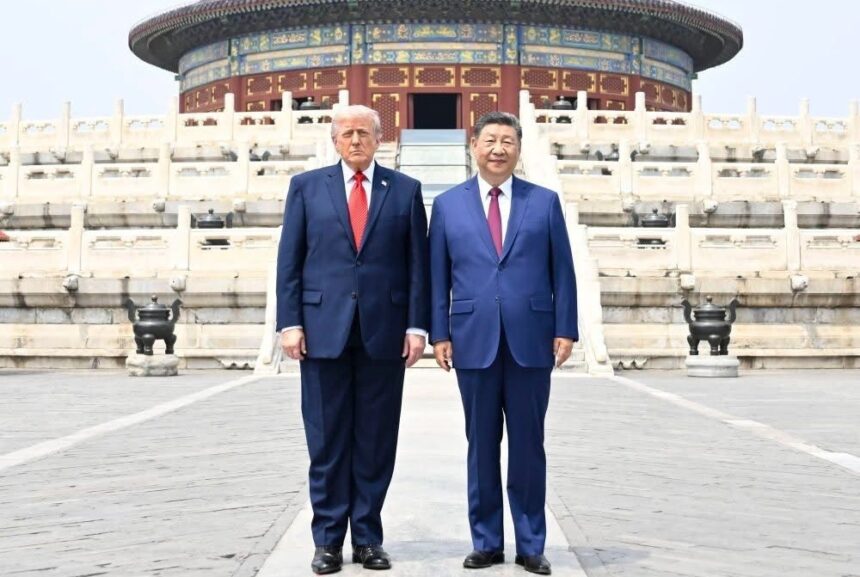
The recent visit of Donald Trump to China, and the grand reception hosted by Xi Jinping, was far more than a routine diplomatic engagement. It symbolized a profound shift in the global balance of power and reflected the emerging realities of a rapidly transforming international order.
What stood out most during the visit was Trump’s tone and manner of speech. Known for his assertive, often confrontational rhetoric, Trump appeared unusually measured, respectful, and restrained in Beijing. His language carried a degree of courtesy and political caution rarely associated with his public persona. He spoke of China not merely as a nation-state, but as an ancient civilization, a decisive global actor, and a country worthy of recognition and respect.
This shift becomes even more meaningful when compared with Trump’s engagements in the Middle East. In Riyadh, Doha, and Abu Dhabi, his rhetoric often reflected the posture of a dominant power speaking to dependent allies. His tone was commanding, authoritative, and at times paternalistic — as though a superior force was dictating terms to subordinates.
Beijing, however, presented a fundamentally different reality. There, Trump encountered a powerful leadership, a confident political system, and a nation possessing not only economic influence but also historical depth, civilizational prestige, and strategic weight in global affairs. Faced with such a reality, even Trump’s political language underwent a noticeable transformation.
This moment highlights a broader truth about the modern international system: the era of uncontested unipolar dominance is gradually fading. The world is increasingly moving toward multipolarity, where influence is distributed among several major powers rather than concentrated in a single capital. Alongside China, countries such as Russia, India, and other rising states are reshaping the geopolitical landscape and redefining global power dynamics.
China’s rise is not solely economic; it is deeply rooted in historical continuity, strategic patience, technological advancement, and national confidence. Today, Beijing occupies a central role in global trade, manufacturing, diplomacy, and strategic competition. This growing influence has compelled even Washington to acknowledge that sustainable global leadership can no longer be maintained through pressure, unilateralism, or dominance alone.
Trump and politicians who share his worldview must recognize an important reality: America cannot preserve its greatness in isolation from the rest of the world. True leadership in the twenty-first century depends on engagement, mutual respect, and balanced international cooperation rather than coercion and superiority.
What unfolded in Beijing was therefore more than a ceremonial diplomatic encounter. It was a symbolic reflection of a changing world order — a world in which power is no longer concentrated exclusively in Washington, and where emerging centers of influence are demanding recognition on equal terms.