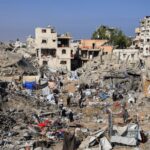
In recent days, the Middle East and our wider region have witnessed two developments whose consequences will not be limited to Gaza and Syria, but will profoundly affect the future of the entire region. The first is the establishment of Donald Trump’s so-called “Peace Council” for Gaza, and the second is the beginning of the transfer of thousands of ISIS prisoners from Syria to Iraq. At first glance, these two events may appear unrelated, but when viewed strategically, they are part of a single design: the commercialization of war and the geographical relocation of terrorism.
The so-called Peace Council has been created in the form of a commercial enterprise. Its executive leadership consists largely of billionaires involved in construction, real estate, and large development projects. If this plan succeeds, the people of Gaza will be expelled from their land and transferred to Somaliland, where a leisure and tourism city will be built — the same “tourist paradise” Donald Trump once openly envisioned. In other words, the ruins of a nation and the suffering of its people will be turned into an investment opportunity.
The most dangerous aspect of this project is that it redefines the nature of the state itself. Governments are no longer seen as representatives of their peoples, but as commercial corporations. Nations become consumers, and war becomes a profitable enterprise. If this model succeeds, the Middle East will move from a system of states to a system of companies. This would mark the emergence of a “private-sector United Nations,” a global order driven not by justice, but by profit, and not by peace, but by contracts.
At the same time, the transfer of nearly seven thousand ISIS prisoners from Syria to Iraq has begun. This move is justified by recent fighting in Syria and the weakening of Kurdish forces. Yet the same Kurdish forces had guarded these prisoners for years. The question is unavoidable: if non-state actors were capable of containing these detainees, why is a formal state now portrayed as incapable of doing so? Is this truly a matter of capacity, or is it a deliberate strategic decision?
Iraq itself is burdened by deep political, economic, and security crises. Moving ISIS prisoners into such a fragile environment is effectively planting the seeds of future instability. This is not merely an administrative measure; it is a strategic relocation of ISIS. From Syria, the group is being moved one step closer to Iran and Afghanistan, opening the door to a new battlefield and a new phase of regional insecurity.
Here the two developments converge: on one side, war is transformed into a commercial project; on the other, terrorism remains a political instrument. ISIS is no longer just a terrorist organization; it has become part of broader geopolitical calculations. At times it is used to justify military presence, at times to prolong conflict, and at times to destabilize specific regions.
In this new game, China must not remain indifferent. Beijing, which has made massive investments in regional infrastructure, energy security, and the Belt and Road Initiative, must recognize that the relocation of ISIS is not merely a Middle Eastern problem but a direct threat to the stability of Central and South Asia. The fire that is being moved today from Syria to Iraq could tomorrow reach Iran, Afghanistan, and even China’s western regions. If China seeks to protect its strategic economic corridors, it must treat these developments as a serious security challenge rather than distant news.
At the same time, Pakistan appears once again ready to assume its traditional role as a hired intermediary. A country that for decades has used the language of counterterrorism to secure political leverage and financial aid now seeks once more to present itself as a frontline state in the so-called fight against ISIS, while extremist networks continue to survive within its borders. If a new geographical base for ISIS is being prepared, Pakistan risks repeating its old pattern: hosting proxy conflicts, exporting instability, and extracting international concessions in return.
Western policy also reveals deep contradictions. On one hand, figures such as Ahmad al-Sharaa are welcomed as symbols of stability in Syria; on the other, ISIS prisoners are quietly relocated. If genuine stability were the goal, priority would be given to transparent trials, strict containment, and ideological confrontation with extremism, rather than shifting militants from one vulnerable region to another.
These developments indicate that the region is entering a new phase of conflict — one that is both economic and security-driven. Palestine is being emptied in the name of development, ISIS is being repositioned in the name of security, and entire populations are reduced to collateral damage in a broader strategic game. A region already exhausted by decades of war now faces a new era in which war becomes an investment project and peace becomes a contractual arrangement.
Afghanistan, Iran, and other regional states must not view these changes as isolated news events, but as long-term strategic threats. If today Gaza is turned into a tourist zone and ISIS is moved into Iraq, tomorrow the same logic may be applied elsewhere. History shows that when war becomes a market, justice becomes cheap and human lives become the easiest currency.
If the world truly seeks peace, then peace must be built on the land, dignity, and future of peoples — not on the capital of billionaires and the profits of war. As long as war is conducted under the names of councils, companies, and contracts, the Middle East will not move toward stability, but toward a new and more dangerous form of disorder.
Business in the Name of Peace and War in the Name of ISIS: A New Dangerous Game for the Region



Leave a Comment