


Farmers in Punjab are grappling with significant financial setbacks as the closure of trade routes between Afghanistan and Pakistan has severely hampered the export of kinu (oranges) and potatoes, both of which are in surplus this season.
The standoff, attributed to escalating tensions, has halted exports that previously flowed through Afghanistan to Central Asian countries—key markets for Pakistani produce. With the border closed for approximately four months, farmers and exporters are feeling the strain of lost opportunities and increased costs.
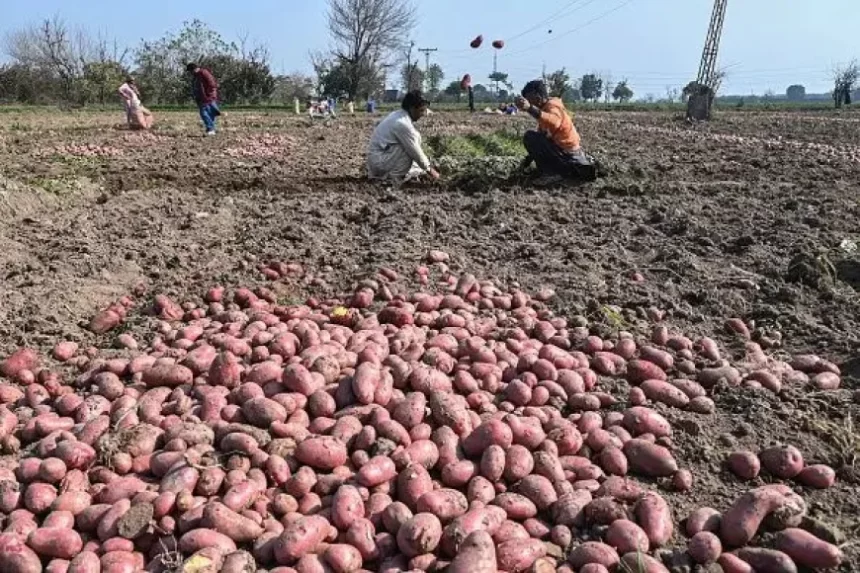
Hammad Rasool, a major exporter from Kot Momin in Sargodha, reported that losses have hit potato producers particularly hard. “Many farmers are opting not to harvest their potatoes due to plummeting prices,” he said. This drastic measure arises from prices falling below production costs, forcing many to plant alternative crops instead.
While Rasool acknowledges the decline in potato exports, he believes that the woes facing the orange sector are not solely due to the Afghan border’s closure. “The quality of Pakistani kinu has sharply declined, which further reduces global demand,” he noted.
This year, Sargodha’s kinu harvest is expected to yield around 1.8 million tons, with about 400,000 to 500,000 tons intended for export. However, Rasool claims that exporting even 100,000 tons is now viewed as a significant achievement given the current challenges. According to him, Central Asian nations once received about 45% of Sargodha’s kinu, but the closure of trade routes has severely disrupted this vital economic lifeline.
The Pakistani government recently granted permission for exports to resume via alternative routes through Iran, but Rasool criticized this move as too late. He expressed concerns about spoilage due to the longer transit times. “The Iran route is not suitable for kinu because of its length and higher costs,” he stated.
Wahid Ahmed, Chairman of the Pakistan Fruit and Vegetable Exporters and Traders Association (PFVA), reinforced Rasool’s concerns, arguing that the issue extends beyond trade routes. According to Ahmed, the shelf life of Pakistani kinu has diminished over the years due to reliance on a single outdated variety. “Our export value has plummeted from $250 million to about $100 million in the last five years,” he said, noting that Pakistan has failed to innovate new kinu varieties while competitors like Afghanistan have diversified their offerings.
The situation is equally grim for potato exporters. Hammad Rasool explained that the production cost of a 65-kilogram bag of potatoes has soared to approximately 2,300 rupees, while market prices have sunk to around 1,100 rupees. The effects of the trade blockade have forced many farmers to abandon their harvests entirely.
Wahid Ahmed echoed Rasool’s assessment, highlighting that while recent governmental easing of export restrictions has allowed for some shipments through Iran, the new route results in higher costs and longer transit times—15 to 17 days compared to the 5 to 7 days it used to take via Afghanistan.
In light of these challenges, both farmers and exporters are calling for more substantial government support for marketing their products globally. With established competitors occupying the market space, there is a growing urgency for the government to aid in improving the viability of Pakistani exports.
As the situation develops, the agricultural community in Punjab is left grappling with uncertainty, compelled to navigate a landscape marred by geopolitical tensions and infrastructural challenges.