


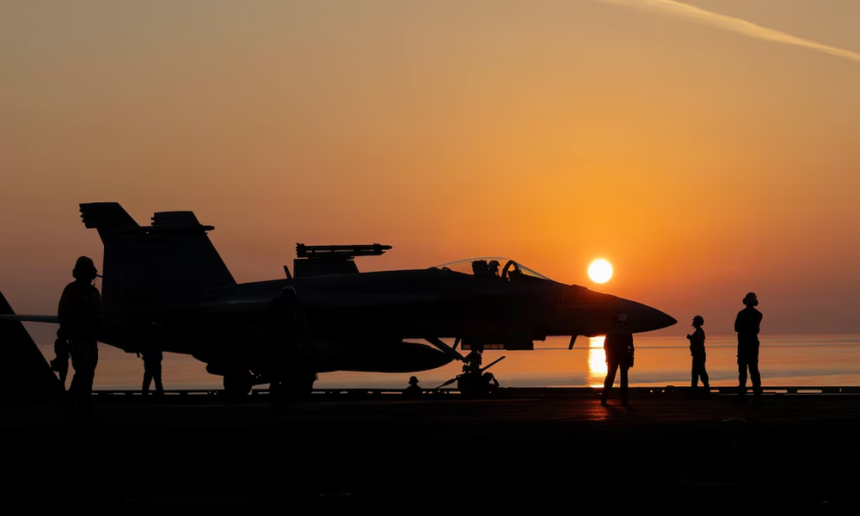
US warplanes struck an Iranian military installation on Qeshm Island in the Strait of Hormuz on November 17, as Bahrain and Kuwait reported fresh aerial attacks and diplomatic efforts continued to prevent further escalation across the Gulf.
A US military official told Reuters that American aircraft targeted a site belonging to Iran’s Islamic Revolutionary Guard Corps (IRGC), in response to attacks on US personnel and military assets.
Ahmad Nafisi, deputy governor of Iran’s Hormozgan province, confirmed the strikes on Qeshm Island but said residential areas, businesses and critical infrastructure had not been damaged. He did not provide details of casualties or damage to military facilities.
Earlier, the IRGC claimed it had struck a US military radar system at Bahrain’s Sheikh Isa Air Base using drones. It described the attack as retaliation for what it called repeated violations of Iranian airspace by American military drones.
However, US Central Command rejected the claim, saying the incoming drones had been intercepted without causing damage to American equipment or injuring US personnel.
Bahrain, which hosts the US Navy’s Fifth Fleet, reported further aerial interceptions in the early hours of November 18, accusing Iran of continuing attacks against the kingdom. The Interior Ministry issued two emergency alerts instructing residents to seek shelter before announcing that the threat had passed.
Kuwait’s military also reported that its air defence systems were engaging hostile drones, although it did not identify their origin or provide details of casualties or damage.
Shipping tensions escalate in Strait of Hormuz
The latest military exchanges coincided with further reports of attacks on commercial shipping in the Strait of Hormuz, a critical international energy and trade route.
Iran’s Revolutionary Guards said a tanker caught fire after striking a mine near Oman’s Ghanam Island while travelling along a route that Tehran had not authorized. The statement did not identify the vessel or provide information about its crew.
Iranian forces also reported fires aboard other vessels in the strait, although Reuters said it could not independently verify the claims.
Separately, the United Kingdom Maritime Trade Operations (UKMTO) agency reported that the crew of a tanker attacked north of Oman’s port of Khasab could not be accounted for.
The vessel, which was first attacked on November 16, reportedly sustained a second strike and caught fire again.
Diplomatic efforts continue
Despite the renewed military activity, diplomatic efforts to contain the conflict continued, with Qatar and Oman maintaining contacts aimed at reducing tensions between Washington and Tehran.
Qatari Foreign Ministry spokesman Majed Al Ansari said on November 17 that mediation efforts to narrow differences between the two sides were ongoing.
He warned that further escalation threatened maritime navigation, the global economy and the prospects of reaching an agreement, urging all parties to exercise restraint.
Iranian Foreign Minister Abbas Araghchi also travelled to Oman, where he met Sultan Haitham bin Tarik and Foreign Minister Badr Albusaidi.
Oman’s Foreign Ministry said the discussions focused on efforts to de-escalate tensions and create conditions for a peaceful resolution to the crisis.
In Ankara, Turkish Foreign Minister Hakan Fidan called for the reopening of the Strait of Hormuz and a swift, positive conclusion to negotiations between the United States and Iran.
Fidan urged Tehran to demonstrate its willingness to resolve the dispute, stressing the importance of restoring safe maritime navigation and addressing the security concerns of neighbouring countries.
The conflict began on February 28 with US-Israeli strikes against Iran. Washington has maintained a blockade of Iranian ports, while Tehran continues to restrict shipping through the Strait of Hormuz.
Disagreements over maritime access and the US blockade remain major obstacles to diplomatic efforts to end the conflict.