



By Ma Tong
China never seeks a trade surplus and opposes unilateral tariff measures in all forms, a Chinese Foreign Ministry spokesperson said on Monday, urging the US to safeguard the hard-won positive momentum in bilateral economic and trade relations, after US Treasury Secretary Scott Bessent’s call for G20 members to reassess their trade terms with China.
China‑US economic and trade ties are mutually beneficial in nature, Guo Jiakun, the spokesperson said. “Committed to high‑standard opening up, China, with its vast market, offers new opportunities to all, including the US,” he added.
Bessent told Reuters on Sunday, ahead of a meeting of G20 finance ministers and central bank governors, that he will encourage G20 member countries to “re-examine” their trade terms with China as part of efforts to shrink the so-called “global imbalances” and press China to rely less on exports.
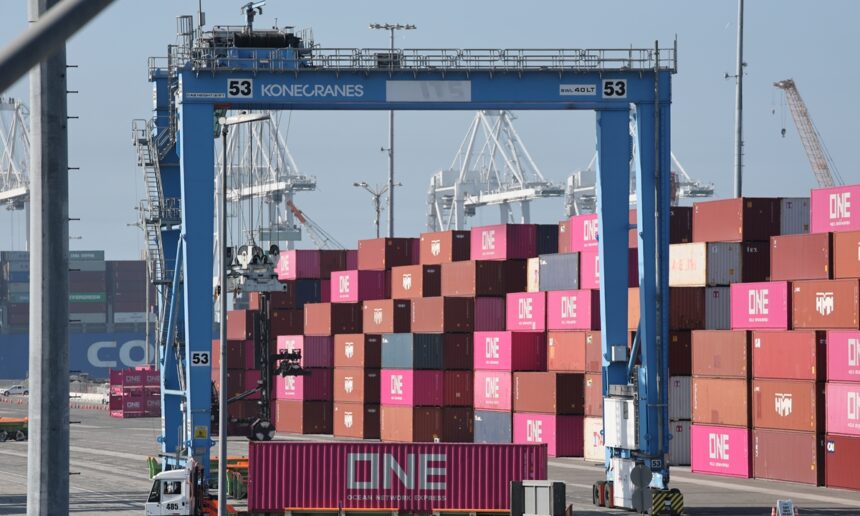
Bessent described the current level of Chinese exports as “unsustainable,” even as he acknowledged that the US’ direct trade position with China was “rapidly improving.” He also claimed that the world could not allow China to run a $1.2 trillion trade surplus, according to Reuters.
The US Treasury chief’s remarks came as the US, which holds the G20 presidency this year, has made “excessive global imbalances” a priority of the 2026 G20 Finance Track. G20 finance leaders are meeting in Asheville, North Carolina, on Monday and Tuesday.
Washington’s push was more an exercise in “political mobilization” ahead of talks with finance chiefs from major US allies and other leading economies than a policy prescription grounded in market logic and multilateral trade rules, Li Yong, an executive council member of the China Society for World Trade Organization Studies, told the Global Times on Monday.
By bringing the issue to the G20, the US is seeking to turn an economic question into a political one and rally other economies into what Li called “bloc-based economies” and “bloc-based trade” targeting China, adding “Rather than blaming China, the US should ask why its own economy can no longer provide such supply competitively.”
International trade is shaped by comparative advantage, global demand and supply capacity, Li said. “Trade does not require perfectly balanced imports and exports, and a surplus alone does not make one country responsible for global imbalances.”
The latest IMF assessment also undercuts attempts to pin global imbalances on one side alone. The agency said in its July 2026 External Sector Report that coordinated domestic policy action would deliver the best global outcome, while rebalancing by one country alone could pose financial-market risks and weigh on growth.
The IMF estimated that China’s current-account surplus stood at about 3.3 percent of GDP in 2025. China’s Ministry of Commerce (MOFCOM) said in July that the ratio stood at about 3.7 percent, still within the internationally recognized reasonable range.
Li said that China’s trade with G20 members and other economies is ultimately shaped by global demand, supply capacity and market competition.
“If there is demand, someone has to supply it,” Li said. “China’s export strength reflects manufacturers’ ability to respond quickly to overseas demand with competitive prices, quality and faster product upgrades, rather than an effort to shift domestic economic problems abroad,” he added.
By contrast, the US has failed to fully recognize and address its own structural problems, from declining manufacturing capacity to excessive financialization, while increasingly turning to protectionism that is harming its own economy, its allies and the broader global trading system, the expert added.
If a trade surplus alone signaled economic imbalance, the same logic would apply to the US, which has long run a sizeable surplus in services trade, analysts said. According to the US Bureau of Economic Analysis, its services surplus rose 8.9 percent in 2025 to $339.5 billion.
Recent trade data also undercuts the portrayal of China as simply relying on exports to offset domestic weakness. In the first seven months of 2026, China’s goods imports surged 22.0 percent year-on-year, outpacing a 14.0 percent rise in exports, official data showed.
Bessent claimed that US tariffs and outright bans on some Chinese products, including autos, had redirected trade flows, with more Chinese exports moving to other markets, while urging other countries to “examine their terms of trade” with China, Reuters reported.
Li warned that the US attempt to use political coordination to push other economies toward trade restrictions runs against market principles and WTO rules and could further fragment the global trading system, rather than address the structural roots of global imbalances.
In a July position paper on the so-called excess capacity issue, the MOFCOM said that China has never sought a trade surplus for its own sake, stressing that the surplus may be recorded in China, but the benefits are shared by all sides. It also noted that while China runs a relatively large goods trade surplus, it records deficits in services trade and investment income.
On Monday, Guo said that China and the US need to act on the important common understandings reached between the two presidents, resolve outstanding issues through consultation on the basis of equality, mutual respect and mutual benefit, and strive to maintain the hard‑won positive momentum in bilateral trade.