


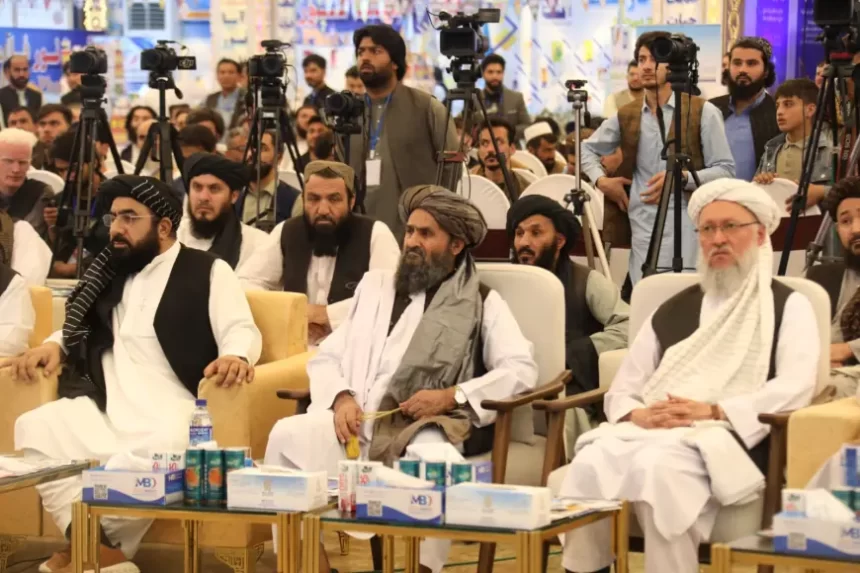
Mullah Abdul Ghani Baradar Akhund, Deputy Prime Minister for Economic Affairs, has officially opened the Second National and International Specialized Exhibition of Abu Ali Sina Balkhi, urging the public to have confidence in and make use of domestically produced medicines.
According to a statement released today, Tuesday, by the press office of the Economic Deputy Prime Minister, Mullah Baradar inaugurated the exhibition, emphasizing that significant strides have been made to strengthen Afghanistan’s pharmaceutical sector. He noted that a substantial portion of the population’s medical needs is now being met through local manufacturing.
Addressing external pressures and economic sanctions, the Deputy Prime Minister stressed that bolstering domestic production is the most effective response. He highlighted that a recent decline in medicine imports has spurred short-term but notable growth in Afghanistan’s pharmaceutical industry, with citizens increasingly turning to local alternatives over imported drugs.
However, he cautioned that these achievements are insufficient given the country’s needs. He called for pharmaceutical factories to further standardize their operations and expand production in line with internationally accepted standards.
Mullah Baradar described the exhibition as a vital platform for advancing the pharmaceutical sector. He appealed to healthcare officials and the general public to trust and utilize local medicines, while also urging traders and sellers to avoid price gouging and hoarding. He called on relevant authorities to strictly enforce measures against such practices.
The Deputy Prime Minister also invited investors to put their capital into Afghanistan, assuring them of the Islamic Emirate’s full support. He announced that efforts are underway to simplify investment procedures, with an electronic system to be introduced gradually.
Beyond domestic economic growth, Mullah Baradar noted that the Islamic Emirate is actively seeking to expand regional and international economic ties, adding that interactions with neighboring and regional countries have already intensified.
During the four-day exhibition, dozens of pharmaceutical companies are showcasing their products. Currently, 134 factories are operating across the country, producing 1,170 types of medicines. These facilities have attracted $450 million in investment and now meet 38% of national demand—up from just 25% eight months ago. This growth is largely attributed to reduced imports of foreign medicines.
In closing, the Deputy Prime Minister once again urged the public to place their trust in and use medicines made in Afghanistan.