


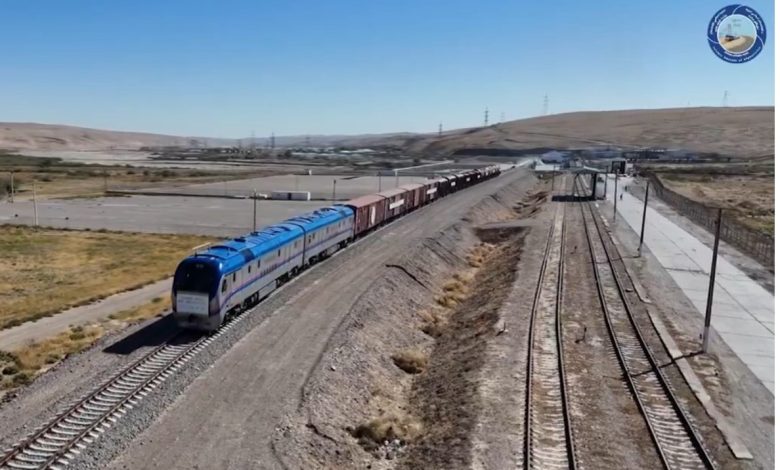
Afghanistan currently possesses around 400 kilometers of main and subsidiary railway lines, which connect four key border ports – Hairatan, Aqina, Torghundi, and the Herat–Khaf railway – with Uzbekistan, Turkmenistan, and Iran.
According to the Ministry of Public Works, in order to further expand this network, construction work is underway on the first phase of the fourth section of the Herat–Khaf railway, as well as the reconstruction of the Hairatan–Mazar-i-Sharif line.
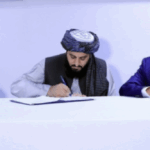
The ministry also stated that a memorandum of understanding, worth 500 million dollars, has been signed with Kazakhstan for the construction of the Torghundi–Herat and Herat–Kandahar railways.
The ministry’s spokesperson, Mohammad Ashraf Haqshinas, said: “For the further development of the country’s railway networks, construction work is ongoing on the first phase of the fourth section of the Herat–Khaf railway, and the repair of the Hairatan–Mazar-i-Sharif line. At the same time, agreements worth 500 million dollars have been signed with Kazakhstan for the construction of the Torghundi–Herat and Herat–Kandahar railways.”
The ministry added that in the field of port infrastructure, an agreement worth 5 million dollars has been signed with Turkmenistan for the expansion of the Torghundi port, with practical work expected to begin soon.
Haqshinasfurther explained that the contract for the detailed survey and design of the Herat–Kandahar railway – with a total length of 737 kilometers and a value of 264 million dollars – has been finalized with the private sector, and work is currently underway. He noted that the survey and design of the 737-kilometer route has been divided into five sections under a contract worth 264 million Afghanis between the Ministry of Public Works and the private sector, and practical work has already started.
Economic experts believe that once the railway network is completed, Afghanistan will emerge as a transit hub of the region.
Economic analyst Mohammad Nabi Afghan added: “In trade and economy, the most important sector is transport, as without it, exchange cannot take place. Among these important sectors, after maritime shipping, railways come next. However, since Afghanistan cannot connect to sea routes, we must prioritize railways. If we simultaneously work on three to four sections quickly, we will be able to build them, maintain them, and even achieve self-sufficiency in this field – because Afghanistan lies at the heart of Asia.”
It is noteworthy that the survey of the 561-kilometer railway line from Balkh to Herat has been completed by Uzbekistan. According to the Ministry of Public Works, if these projects and transit agreements such as “Afghan Trans” are implemented, Afghanistan will become a key regional transportation hub, providing fast and easy transfer of goods between Central and South Asia.